
A NEMA 14-50 outlet installation for EV charging is a dedicated 240-volt circuit: a 50-amp two-pole GFCI breaker, 6 AWG copper wire, and an industrial-grade 14-50 receptacle. Florida requires a permit for it. The work takes 2–4 hours, and labor and materials start at $400 when the panel has room. The receptacle is the cheapest part of the job. It is also the part most likely to fail.
What a NEMA 14-50 outlet is
It is a four-slot, 50-amp, 125/250-volt receptacle. Two hots, a neutral, a ground. It was designed for electric ranges and RV hookups. Most plug-in Level 2 chargers ship with a 14-50 plug, so it became the default EV outlet.
What changed is how it gets used. A range works hard on Thanksgiving. A car works hard every night.
NEMA 14-50 outlet for EV charging: how fast it is
A Level 2 charger on a 50-amp circuit adds 25–35 miles of range per hour. A standard 120-volt outlet adds 3–4. The Department of Energy's home charging page makes the same comparison.
The charger does not get the full 50 amps. Code treats EV charging as a continuous load, so the circuit has to be rated at 125% of what the charger pulls. On a 50-amp circuit, the charger is set to 40 amps. Tesla's Mobile Connector with the 14-50 adapter pulls 32. If your charger has an amperage setting, we set it during the install and show you where it is.
Breaker and wire size for a 14-50 outlet
- —Breaker: 50-amp, two-pole, GFCI
- —Wire: 6 AWG copper, four conductors — two hots, neutral, ground
- —Circuit: dedicated. Nothing else on it. NEC 625.40 requires that.
- —Receptacle: industrial-grade, rated for EV use
- —Terminals: torqued to the manufacturer's number with a torque screwdriver, not by feel
Do not put a 14-50 on your dryer circuit. A dryer circuit is 30 amps on 10 AWG wire. Swapping the dryer receptacle for a 14-50 and plugging in a car puts 40 amps on wire sized for 30, for hours at a time. That is how garage fires start. If you already have a 14-50 from an old range or RV hookup, it may work. Have the wire size and breaker checked before the first charge.
Does your panel have room
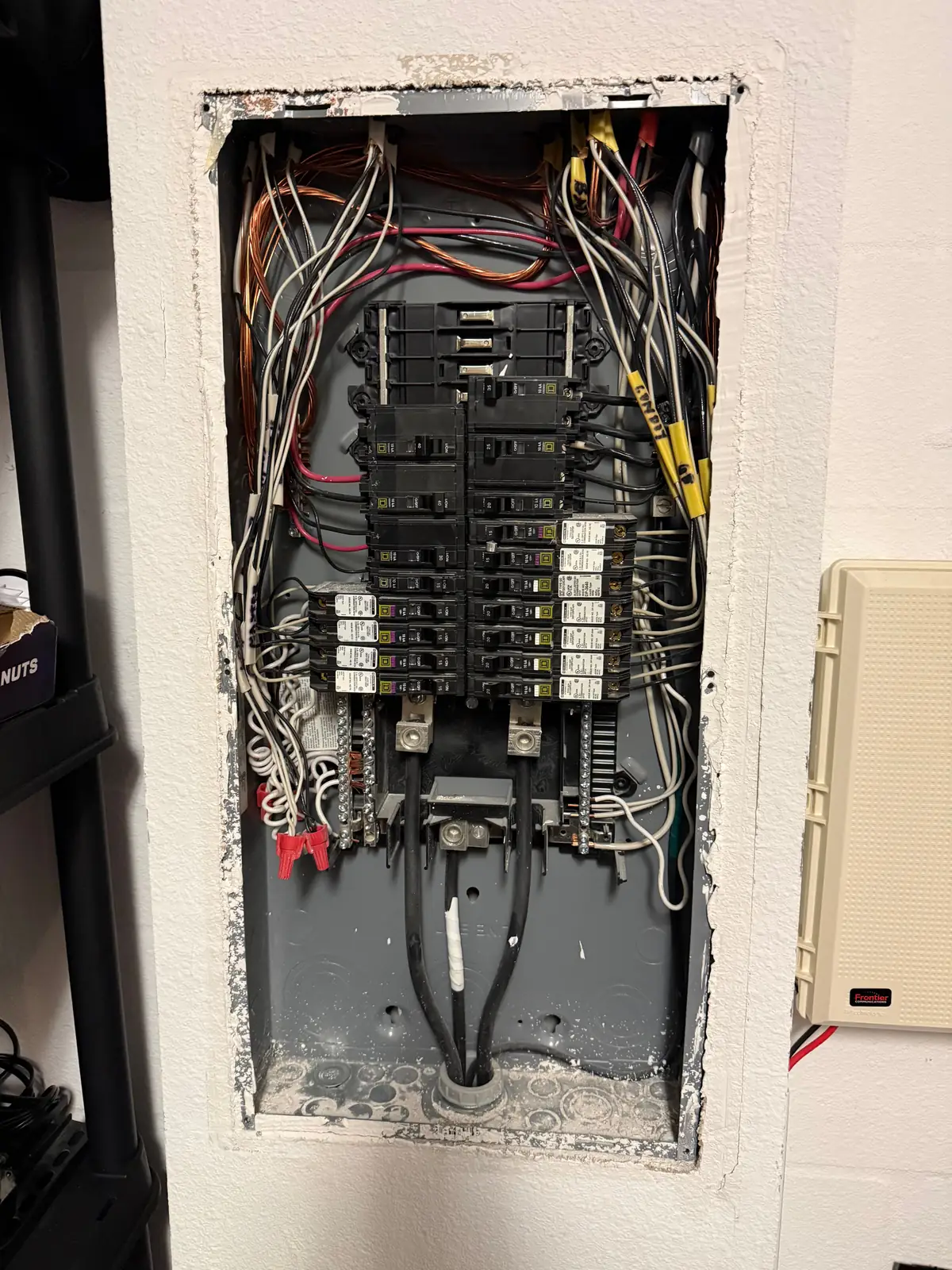
The circuit needs two open breaker spaces and spare capacity. The spaces are easy to see. The capacity takes a load calculation. A 100-amp panel already running central AC, an electric range, and an electric water heater usually does not have 40 amps to spare for six hours a night.
We run the numbers at the $89 diagnostic. If the panel is short, the options are load management or a panel upgrade, which starts at $2,911 for 200-amp service. You hear which one before anything is scheduled.
Does a NEMA 14-50 need GFCI
Yes. Two separate rules require it. NEC 210.8(A) covers 125–250-volt receptacles in garages and outdoors. NEC 625.54 covers every receptacle installed for EV charging, wherever it is. Florida builds to the 2020 National Electrical Code through the Florida Building Code, 8th edition, in force since December 31, 2023. A 14-50 installed for a car in Pasco, Hillsborough, or Pinellas gets a GFCI breaker. There is no exception for a garage that only you use.
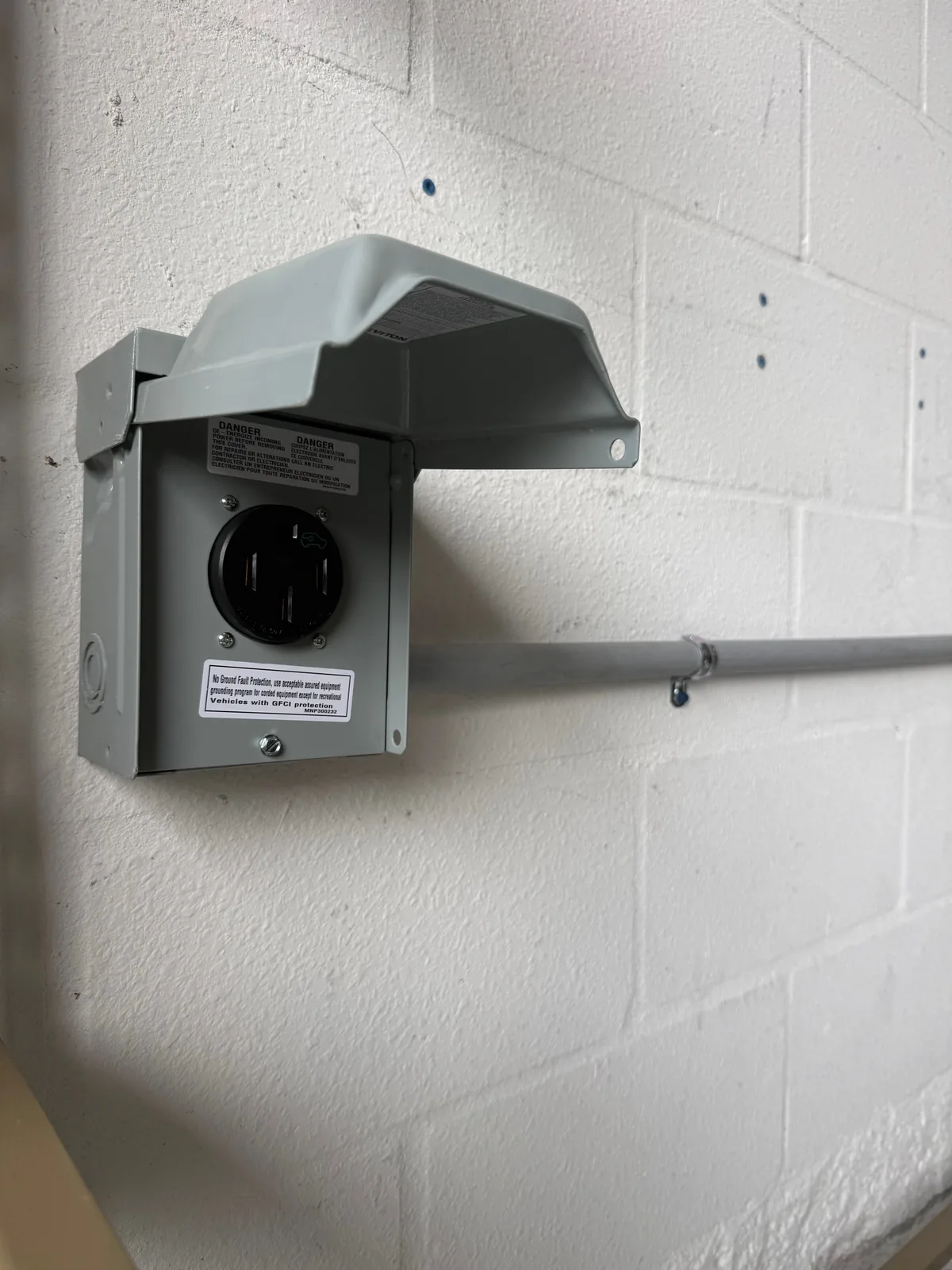
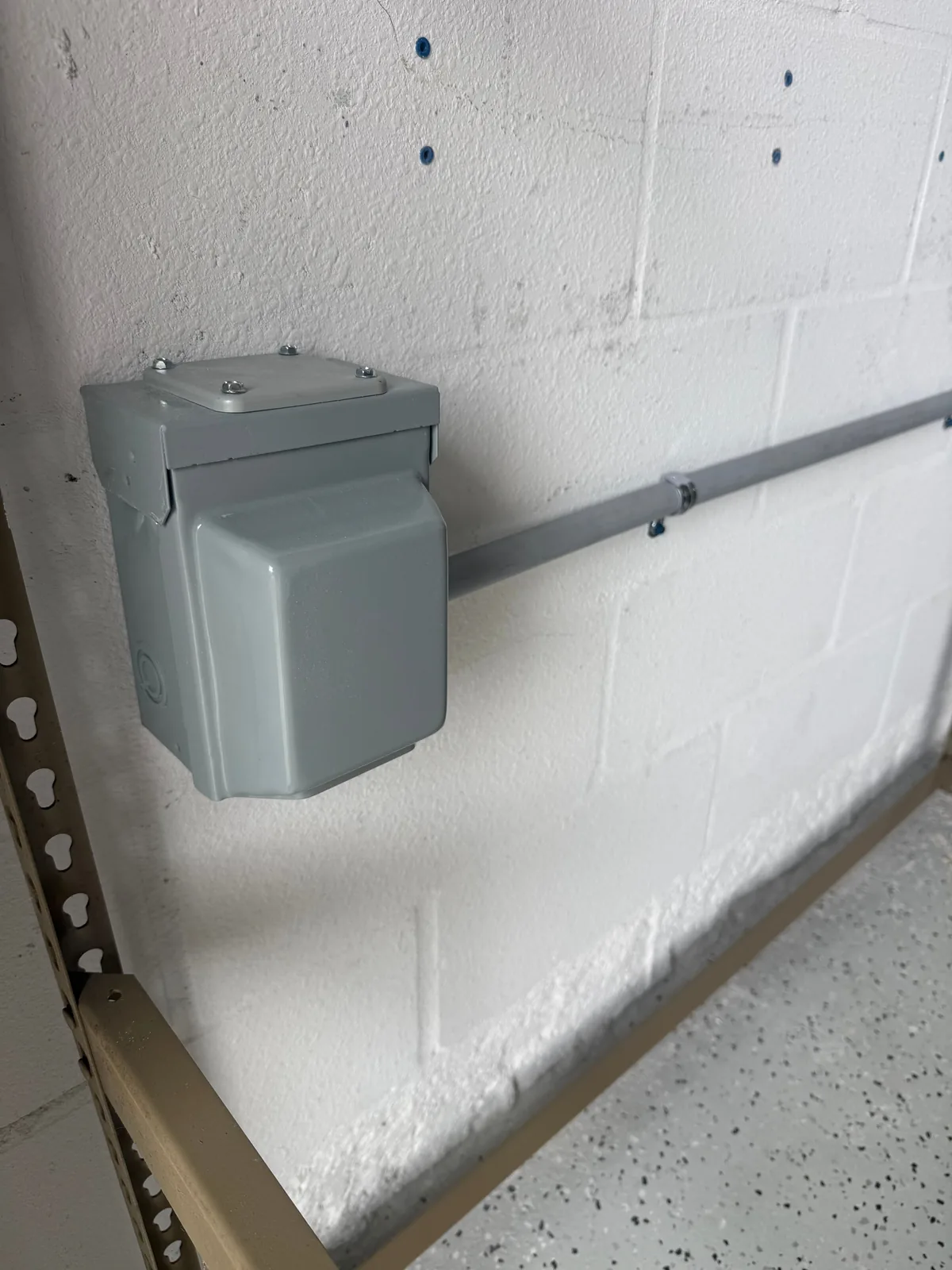
The protection lives in the breaker, not the outlet. The outdoor enclosure in the photos below says so on its own label: no ground fault protection inside. A 50-amp two-pole GFCI breaker runs $114.35 to $183 at Home Depot, depending on the panel brand. It is the most expensive part in the box.
Why the charger trips the GFCI breaker
Most chargers carry their own ground-fault protection inside. Put a GFCI breaker in front of that and you have two devices watching for the same fault. The charger runs a self-test at startup, the breaker reads it as leakage, and the car does not charge overnight.
The fixes, in the order we try them: a charger firmware update, a different GFCI breaker, then hardwiring. A hardwired charger is not a receptacle, so 625.54 does not apply to it, and the charger's built-in protection does the job. The logic is the same one behind a GFCI outlet that keeps tripping in a bathroom — find what the device is reacting to before replacing anything.
Why NEMA 14-50 outlets melt
A builder-grade 14-50 is made for a range. Its contacts relax a little every time a plug goes in and comes out. A relaxed contact has resistance. Resistance at 40 amps makes heat. Heat relaxes the contact further. It takes months, and nothing looks wrong until the plug face browns.
The same thing happens on a terminal screw tightened by feel. A loose screw heats, the metal around it expands and contracts, and the connection gets looser every night. It is the same failure we see with aluminum wiring, at a much higher current.
What goes in instead: a receptacle built for EV duty. Leviton's EV-marked 1450R is $39.98 at Home Depot. Hubbell's industrial-grade 14-50 is the heavier option. Either way, heavier contacts, a body that does not soften with heat, and terminals torqued to spec. It is still the cheapest part on the invoice.
Stop charging and switch the breaker off if you see any of these:
- —The plug is hot to the touch after an hour of charging
- —Brown or dark marks on the plug face or around the slots
- —The charger reports a temperature fault or drops its current on its own
- —A smell of hot plastic near the outlet
Do not unplug it and plug it back in to see if it helps. Leave the breaker off and call a licensed electrician.
One habit that extends the receptacle's life: leave the charger plugged in. Every insertion wears the contacts a little.
Block walls and coastal air
Most Tampa Bay garages are concrete block. You cannot fish a cable down a hollow stud the way you can in a framed wall. So most of our garage installs run EMT conduit on the surface of the block, like the photo above. It protects the wire, it is easy to inspect, and it can be painted to match the wall.
If the outlet sits outdoors or in an open carport, the enclosure has to stay weatherproof with the plug inserted, not just with the cover shut. Close to the water in Pinellas, salt air works on metal covers and receptacle contacts. Look at the plug face once a year.
NEMA 14-50 vs. hardwired EV charger
A 14-50 is the right call if you want to take the charger with you when you move, swap chargers later without an electrician, or share the outlet with an RV.
It is the wrong call in three cases, and we will tell you so at the diagnostic:
- —You drive a Tesla. The Wall Connector is hardwired. It needs a 60-amp breaker for its full 48-amp output, which is faster than any 14-50 allows. The install costs about the same, and there is no receptacle to wear out.
- —The charger is never leaving. If it stays with the house, the outlet is one more connection that can loosen, and it adds nothing.
- —You drive under about 30 miles a day. A standard 120-volt outlet adds 3–4 miles per hour. Ten hours overnight covers it. You may not need a 240-volt circuit at all. Try it for a month before you pay anyone.
NEMA 14-50 installation cost and permit
Labor and materials start at $400 when the panel has capacity and the garage is close to it. The permit starts at $75, depending on the county, and we pull it. The charger is separate. Grizzl-E and Emporia units run $400–$500. ChargePoint Home Flex and JuiceBox 40 run $500–$700.
What moves the price up: the distance from the panel, the route through block or attic, an outdoor enclosure, the GFCI breaker your panel brand takes, and whether the panel needs work first. The exact number is written down after the $89 diagnostic, before any work starts. You say yes or you say no. If you say no, you pay the $89 and we leave. If you say yes, the $89 goes toward the job.
The full breakdown by scenario is in what EV charger installation costs in Tampa Bay. The service details are on our EV charger installation page. Florida license ER-13016759.
Tony
Licensed Electrical Contractor · ER-13016759 · Tampa Bay, FL
Owner of My Fixer LLC, serving Tampa Bay since 2018. 337 Google reviews at 4.9 stars.
About Anatoliy →Frequently Asked Questions
What size breaker and wire does a NEMA 14-50 outlet need?+
A 50-amp two-pole breaker and 6 AWG copper wire, four conductors: two hots, a neutral, and a ground. For EV charging the breaker must also be GFCI, and the circuit must be dedicated to the charger with nothing else on it.
Does a NEMA 14-50 outlet need a GFCI breaker in Florida?+
Yes, when it is installed for EV charging. Florida builds to the 2020 National Electrical Code, and two sections apply: 210.8(A) for 250-volt receptacles in garages and outdoors, and 625.54 for any receptacle installed for EV charging. A hardwired charger is not a receptacle and uses its own built-in protection instead.
Can I plug my EV charger into my dryer outlet?+
Not by swapping the dryer receptacle for a 14-50. A dryer circuit is 30 amps on 10 AWG wire. A charger on a 14-50 pulls 40 amps for hours at a time. Some chargers can be set to a lower current and fitted with the matching plug, but the circuit has to be checked first, and it cannot be shared with the dryer.
Why does my EV charger keep tripping the GFCI breaker?+
Most chargers have their own ground-fault protection. The charger's startup self-test can read as a fault to the GFCI breaker in front of it. A firmware update or a different GFCI breaker usually fixes it. If neither does, hardwiring the charger removes the conflict.
Why do NEMA 14-50 outlets melt?+
Builder-grade receptacles are made for ranges, which run in short bursts. At 40 amps for six hours a night, a slightly loose contact or terminal screw heats up, loosens further, and heats more. An industrial-grade receptacle with terminals torqued to spec prevents most of it. If the plug is hot or discolored, switch the breaker off and have it checked.
Is a NEMA 14-50 outlet or a hardwired charger better?+
A 14-50 is better if you want to take the charger with you or swap it later. Hardwired is better if the charger stays with the house, and it is required for the Tesla Wall Connector at full output. The installation cost is about the same either way.
How much does NEMA 14-50 outlet installation cost?+
Labor and materials start at $400 when the panel has room and the garage is near it. The permit starts at $75 depending on the county. Distance from the panel, the wiring route, outdoor enclosures, and panel capacity move it up. The exact number is written down after the $89 diagnostic, and the $89 applies toward the job.
How long does a NEMA 14-50 installation take?+
Two to four hours for a standard garage install. The permit inspection follows within a few days, and we schedule it.
Have a Question?
Ask our licensed electrician directly. Electrical and appliance repair specialist. You'll get a reply within minutes.