
A GFCI outlet trips when it detects a difference of as little as 4–6 milliamps between the hot and neutral wires — a sign that current may be leaking to ground somewhere in the circuit. That sensitivity is the point. It's what makes GFCI protection effective in kitchens, bathrooms, garages, and outdoor locations where water and electricity can meet.
One trip after a wet appliance touches an outlet is the GFCI working correctly. Repeated trips with no obvious cause are not normal — and taping over the test button or swapping in a standard outlet to stop the tripping defeats the protection entirely.
Everything on this site — the pricing, the process, the common failure points — is here because hidden information helps no one. Here are the seven causes of repeated GFCI tripping, in order of how often we see them.
Quick Diagnosis Before You Call
Work through this before reaching for the phone. It takes three minutes and rules out the most common causes.
Step 1: Unplug everything from the circuit. Reset the GFCI. Does it hold? If yes, go to cause 1. If it trips immediately with nothing plugged in, go to causes 4, 5, or 7.
Step 2: If it held with nothing plugged in, reconnect devices one at a time. Reset the GFCI after each one. When it trips, the last device you plugged in is the problem.
Step 3: If the GFCI trips with nothing plugged in and you've already tried a new GFCI device, the fault is in the wiring. That's a licensed electrician call.
The 7 Causes of a GFCI That Keeps Tripping
1. A faulty appliance on the circuit
The most common cause. A failing appliance — deteriorating internal insulation, a worn motor, or damaged wiring inside the device — creates a ground fault that the GFCI detects immediately.
Test: unplug everything from the circuit. Reset the GFCI. Start reconnecting devices one at a time, resetting after each one. When it trips again, the last device you plugged in is the problem. Hair dryers, older power tools, and appliances that have been dropped or exposed to moisture are frequent offenders. The appliance is the problem — not the outlet.
2. Moisture or humidity in the outlet box
Florida humidity is persistent and gets into places it shouldn't. Outdoor outlet boxes, garage outlets near hose connections, and bathroom outlets near showers can accumulate enough moisture between the contacts to trigger a GFCI.
An outdoor GFCI that trips after rain, or resets fine but trips again the next morning, is almost always a moisture issue. The fix is a weatherproof in-use cover — the kind that stays sealed even with a plug inserted — and resealing any gaps in the box. If water has been pooling inside repeatedly, the box itself needs to be replaced.
The NEC requires weatherproof covers on all outdoor GFCI outlets and any GFCI that could be exposed to rain or water splash. If yours doesn't have one, start there.
3. Cumulative leakage current from too many devices
GFCIs detect ground faults — not overloads. But a related problem causes what looks like nuisance tripping. Every appliance on a circuit has a small amount of normal leakage current. Individually, each falls below the 4–6 milliamp trip threshold. Add enough of them to the same circuit and the cumulative leakage crosses it.
This is more common in older homes where multiple modern appliances share a circuit designed for the loads of 30 years ago. Symptom: the GFCI trips when several devices are running simultaneously but holds when only one or two are connected.
The fix is either reducing the load on that circuit or adding a dedicated circuit for high-draw devices. An outlet and circuit assessment confirms whether the circuit is appropriately loaded.
4. Faulty wiring upstream of the outlet
A GFCI protects everything downstream on the same circuit. If the wiring between the panel and the GFCI has a fault — a nick in the insulation from a nail or screw, a loose connection at a junction box, or a corroded wire — the GFCI trips even when nothing is plugged into it.
This is the cause that requires a licensed electrician. Tracing a wiring fault means working through the circuit from the panel outward, testing at each junction. Signs this is the cause: the GFCI trips with nothing plugged in, and trips again immediately after resetting — even after trying a new GFCI device.
A wiring fault that causes a GFCI to trip is the same wiring fault that could cause a fire if the GFCI were bypassed. It shouldn't be ignored.
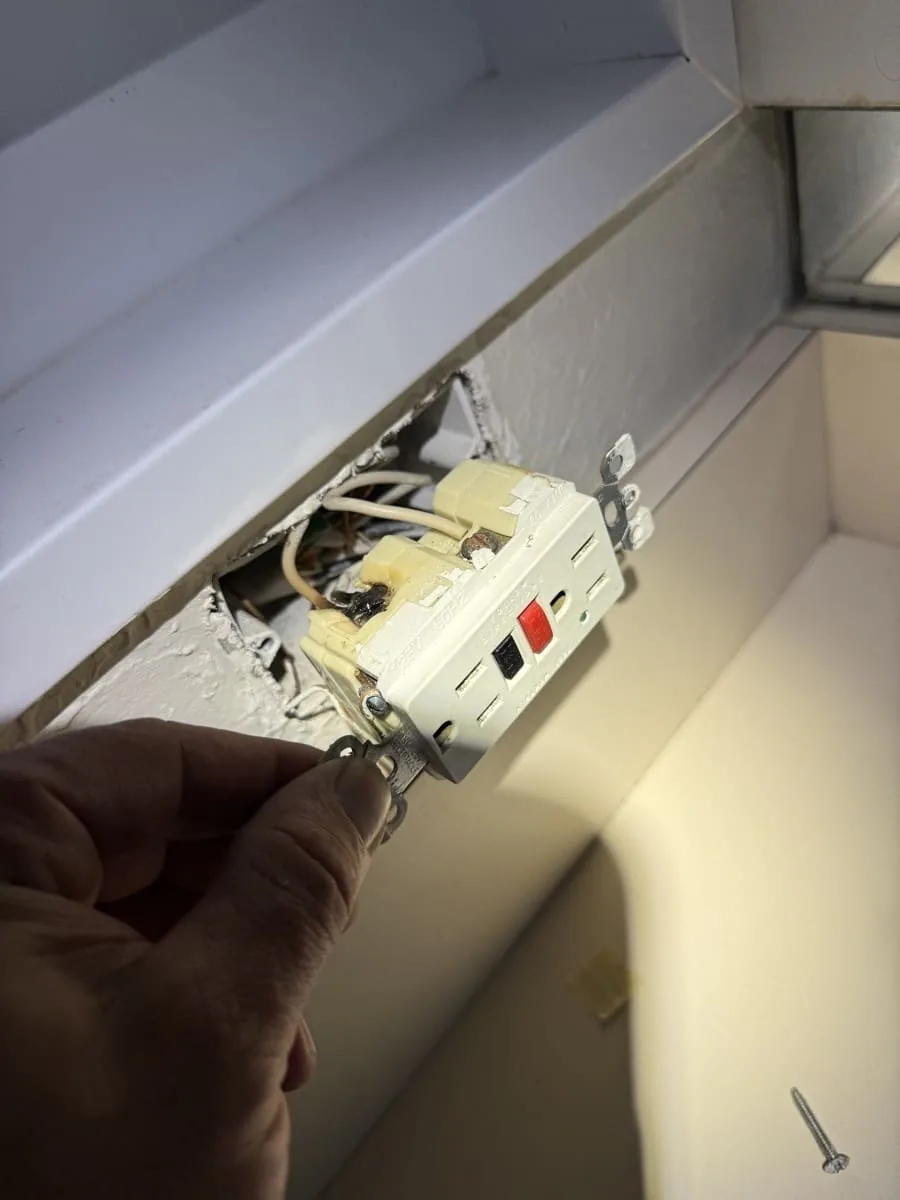
5. The GFCI device itself has failed
GFCI outlets have a mechanical trip mechanism that wears out. The typical rated service life is 10–15 years in Florida conditions. Heat and humidity accelerate the aging of the internal components.
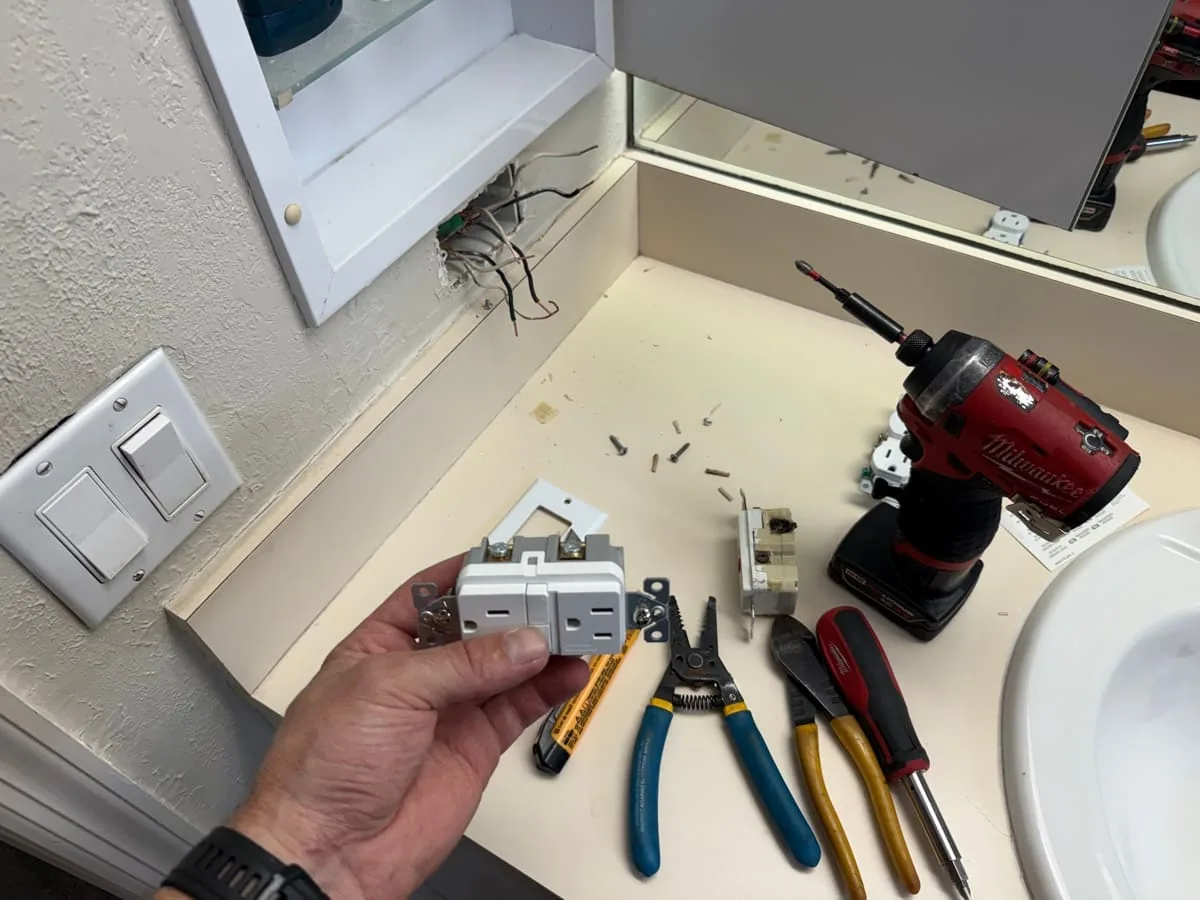
A GFCI that trips with nothing plugged in, that won't reset at all, or that doesn't cut power when you press the Test button is a failed device. A replacement GFCI outlet costs about $15 at a hardware store. If you're comfortable replacing outlets, this is a straightforward swap — turn off the breaker, confirm power is off with a non-contact tester, match the wire connections exactly, and test before closing the box.
If you're not sure which wires go where, call rather than guess. A wiring error on a GFCI defeats its protection function.
6. Power surges from lightning or utility switching
Florida sees more lightning strikes per square mile than almost anywhere in the country. A nearby strike — or a utility company switching event — can send a voltage spike through the wiring that triggers GFCI protection as a side effect.
If your GFCI trips during a storm and resets normally afterward, this is likely the cause. Whole-home surge protection at the panel prevents most of these events from reaching your devices. If lightning-related GFCI trips are a recurring issue, a panel-mounted surge protector is worth adding.
7. Improper wiring — LINE and LOAD terminals reversed
This is the cause most homeowners don't know to check — and one that creates problems you can't diagnose without opening the outlet box.
A GFCI outlet has two sets of terminals: LINE (the incoming hot and neutral from the panel) and LOAD (the outgoing wires to outlets downstream). If the LINE and LOAD wires are reversed — which happens when someone replaces a GFCI without reading the labels — the outlet trips continuously or behaves erratically. The internal circuit can't sense the correct direction of current flow.
The LINE terminals are labeled and often marked with a yellow sticker from the manufacturer. The fix is turning off the breaker, confirming which wires are which, and connecting them to the correct terminals.
If the outlet box has six wires — two in, two out, and a ground — and you're not sure which pair goes where, call us. A reversed GFCI provides no protection even when it appears to work.
How to Use the Test and Reset Buttons
Press the Test button monthly. This should cut power to everything on the GFCI's protected circuit immediately. Press Reset to restore it.
A GFCI that trips and resets immediately with nothing plugged in: worn device or upstream wiring fault.
A GFCI that trips and won't reset at all: upstream fault or failed device.
A GFCI that trips only when a specific device is connected: faulty appliance.
A GFCI that trips after rain: moisture in the box.
A GFCI that trips only when multiple things are running: cumulative leakage.
If the outlet doesn't respond correctly to the Test button — if the button does nothing — replace it even if it appears to be working. A GFCI that doesn't respond to Test is not providing any protection.
Where GFCI Protection Is Required by Code
The NEC requires GFCI protection in bathrooms, kitchens within 6 feet of a sink, garages, outdoors, crawl spaces, unfinished basements, boathouses, and near pools and hot tubs. Florida's building code follows the NEC, and CPSC has pushed GFCI protection in wet locations for decades.
If you have standard outlets in any of these locations — outlets without Test and Reset buttons — they may be out of compliance. A tripped GFCI that gets bypassed with a standard outlet creates a code violation and removes protection in a location where it's required for a reason.
Our outlet and switch repair service covers GFCI replacement, wiring fault diagnosis, LINE/LOAD reversal correction, and code compliance in Pasco, Hillsborough, and Pinellas counties.
Tony
Licensed Electrical Contractor · ER-13016759 · Tampa Bay, FL
Owner of My Fixer LLC, serving Tampa Bay since 2018. 337 Google reviews at 4.9 stars.
About Anatoliy →Frequently Asked Questions
How do I find which outlet is the GFCI for my dead outlets?+
Look in the kitchen, bathrooms, garage, and outdoors for an outlet with Test and Reset buttons. One tripped GFCI can knock out several outlets elsewhere in the home on the same circuit. Reset the GFCI and check whether the dead outlets come back.
Can I replace a GFCI outlet myself in Florida?+
Homeowners in Florida can replace a like-for-like outlet on their own property. Turn off the breaker, confirm power is off with a non-contact tester, match the wire connections exactly — LINE terminals to the incoming wires from the panel, LOAD terminals to the outgoing wires if present. If you're not sure which is which, call us. A wiring error on a GFCI defeats its protection.
How often should GFCI outlets be tested?+
Once a month. Press the Test button — the Reset button should pop out and any devices downstream should lose power. Press Reset to restore. If the outlet doesn't respond correctly to the Test button, replace it. A GFCI that looks functional but doesn't respond to Test is not providing protection.
Why does my outdoor GFCI trip after rain?+
Moisture inside the outlet box. Florida humidity and rain get into outdoor boxes, especially ones with standard covers. The fix is a weatherproof in-use cover — sealed even with a plug inserted — and resealing any gaps. If water has been pooling inside the box repeatedly, the box itself needs replacement.
My GFCI trips with nothing plugged in. What causes that?+
Either a wiring fault upstream — a nick or loose connection in the circuit wiring between the panel and the GFCI — or a worn GFCI device, or reversed LINE/LOAD wiring. Try replacing the GFCI first — it's $15 and rules out the device. If the new GFCI also trips with nothing connected, the fault is in the wiring and needs a licensed electrician to trace.
What is a LINE vs LOAD wiring error on a GFCI?+
A GFCI has two sets of terminals: LINE (incoming power from the panel) and LOAD (outgoing to downstream outlets). If these are reversed during installation, the outlet trips continuously or behaves unpredictably — even though it looks normal from the outside. The fix is opening the box and connecting the wires to the correct labeled terminals.
How long do GFCI outlets last?+
Typically 10–15 years in Florida conditions. Manufacturers rate some devices up to 25 years, but heat and humidity accelerate wear on the internal trip mechanism. If your GFCI is more than 15 years old and tripping frequently, replace it before troubleshooting anything else.
Is it safe to bypass a GFCI outlet that keeps tripping?+
No. A GFCI that trips repeatedly is detecting something — a ground fault, a moisture problem, a wiring issue, or a faulty appliance. Bypassing it with a standard outlet removes protection in a location where it's required by code. Diagnose and fix the cause.
What is the difference between a GFCI outlet and a GFCI breaker?+
A GFCI outlet provides protection at the outlet itself and at all outlets downstream on the same circuit. A GFCI breaker sits in the panel and protects every outlet on that entire circuit. Either satisfies code requirements. GFCI breakers cost more but protect more of the circuit. We use whichever is appropriate for the installation.
Have a Question?
Ask our licensed electrician directly. Electrical and appliance repair specialist. You'll get a reply within minutes.