
A refrigerator that stops cooling is one of the more stressful appliance failures. Food spoils fast in a Florida summer. The problem could be a $15 part or a $600 compressor — there's no way to know without looking.
Every price here is a starting point. The exact number is written down after the $89 diagnostic, before any work starts.
Before you call for repair, work through this list in order. The checks at the top take minutes. The ones at the bottom require a technician. Knowing which category you're in is worth the five minutes it takes.
Start Here: The Quick Checks
1. Power and temperature settings
This is listed first because it is the most frequently overlooked cause and the fastest to rule out. Confirm the refrigerator is plugged in and the outlet is live — plug a phone charger into the same outlet and see if it charges. Check the circuit breaker for the kitchen circuit.
Then check the temperature settings. Someone may have bumped the dial. Refrigerator sections should be set between 35°F and 38°F. Freezer sections should be set at 0°F. If the dial was moved to a warmer setting, the refrigerator will gradually stop cooling — not immediately, but over several hours.
2. Door seals and gaskets
The rubber gaskets around the refrigerator and freezer doors create the seal that keeps cold air in and warm air out. A torn, cracked, or warped gasket lets warm air in continuously. The refrigerator runs constantly trying to compensate but can't keep up.
Test with a dollar bill: close the door on a dollar bill so half is inside and half is outside. Pull it out. If it slides out easily with no resistance, the seal at that point is compromised. Check around the full perimeter of both doors.
Gaskets are a repair most homeowners can do themselves. Replacement gaskets are available for most models and attach with a snap-in channel or screws. If the gasket is in good shape but the door doesn't seal, the door hinges may need adjustment.
3. Refrigerator placement and clearance
Refrigerators need airflow around them to release heat from the condenser. Built too tight against a wall or enclosed in cabinetry without ventilation gaps, the refrigerator can't reject heat efficiently and the interior temperature climbs.
Check the back and sides. Most manufacturers specify a minimum clearance of 1 inch on the sides and 1 inch at the back. Pulling the refrigerator out slightly sometimes resolves the problem without any parts.
The Mechanical Checks
4. Condenser coils
The condenser coils dissipate heat from the refrigerant. On most refrigerators, they're at the back or underneath — accessible by pulling the unit away from the wall or removing the bottom front kick plate.
If the coils are coated with dust and pet hair, the refrigerator can't release heat. The compressor runs harder and longer, and eventually the interior temperature rises enough that cooling fails. This is one of the most common causes of no-cooling calls.
Vacuum the coils with a brush attachment. Takes about 15 minutes. Costs nothing. Clean them every six to twelve months — more often with pets. It's the single most effective refrigerator maintenance task.
5. Blocked air vents inside the freezer
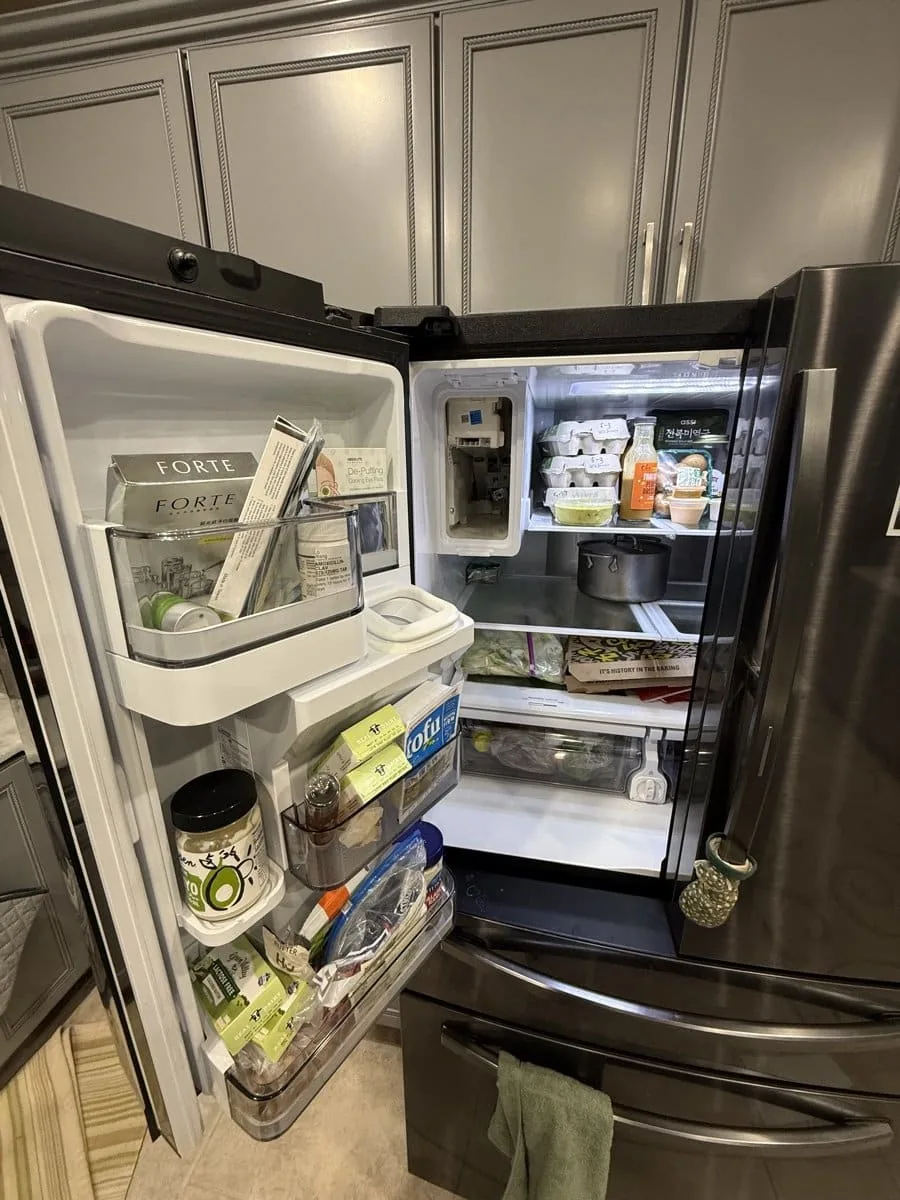
The vents at the back wall of the freezer compartment circulate cold air between the freezer and refrigerator sections. If food items are packed against these vents — boxes of frozen food, bags of ice — airflow is blocked and the refrigerator section warms up while the freezer stays cold.
Check for items pressed against the back wall of the freezer. Rearrange so there's clear space in front of the vents. This takes two minutes.
6. Condenser fan
The condenser fan pulls air across the coils to carry heat away. It's usually near the coils at the back or bottom of the unit. If the fan has stopped — motor failure, a broken blade, or debris jammed in the blades — the coils can't release heat even if they're clean.
Listen for the fan when the compressor is running. If you can hear the compressor but not the fan, or the fan is making a grinding or rattling noise, the fan motor or blade has failed. This is a parts replacement job for a technician.
7. Evaporator fan
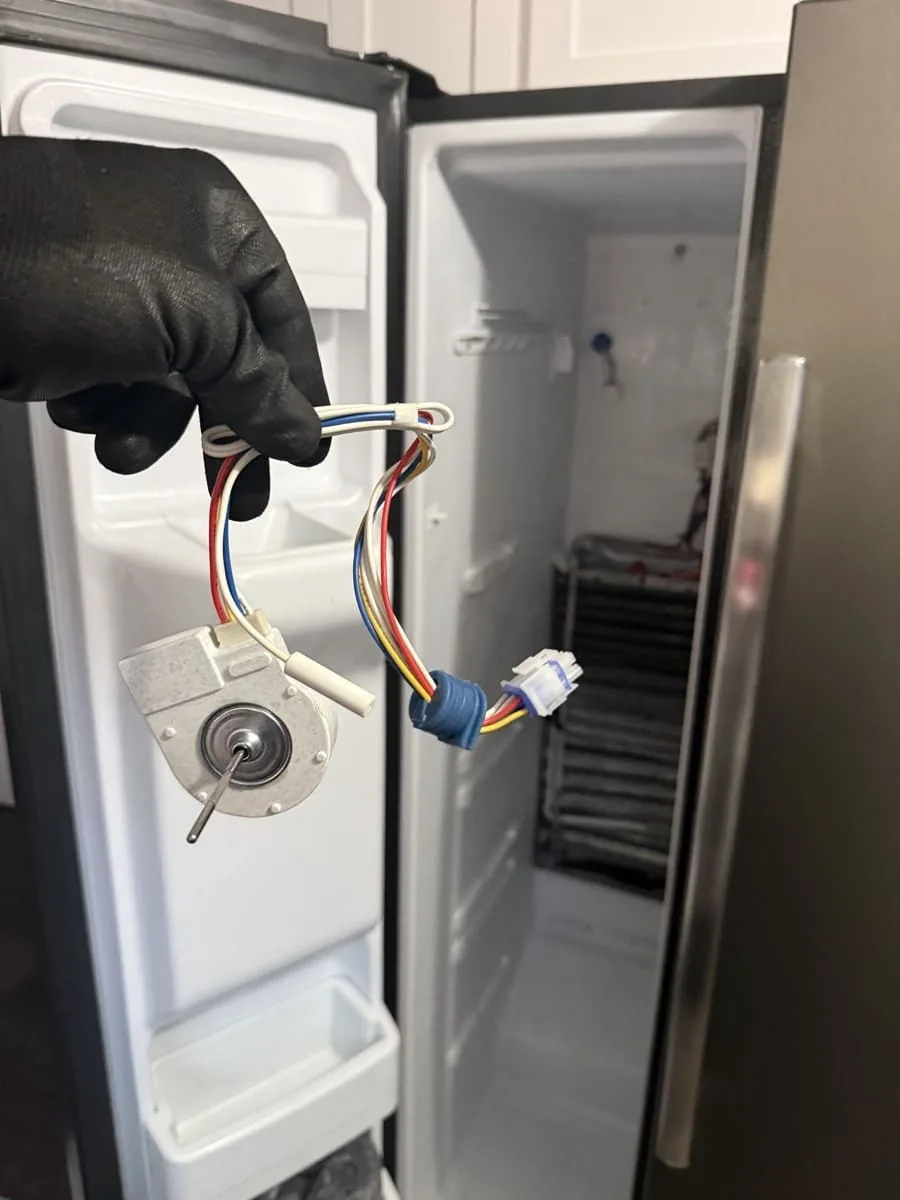
The evaporator fan circulates cold air from the freezer compartment into the refrigerator section. If the freezer is cold but the refrigerator section is warm, the evaporator fan is the first suspect.
Open the freezer and listen. You should hear a fan running when the door is open — some models stop the fan when the door opens, so close it and listen through the door instead. No fan sound, or a loud scraping noise, points to a failed evaporator fan motor.
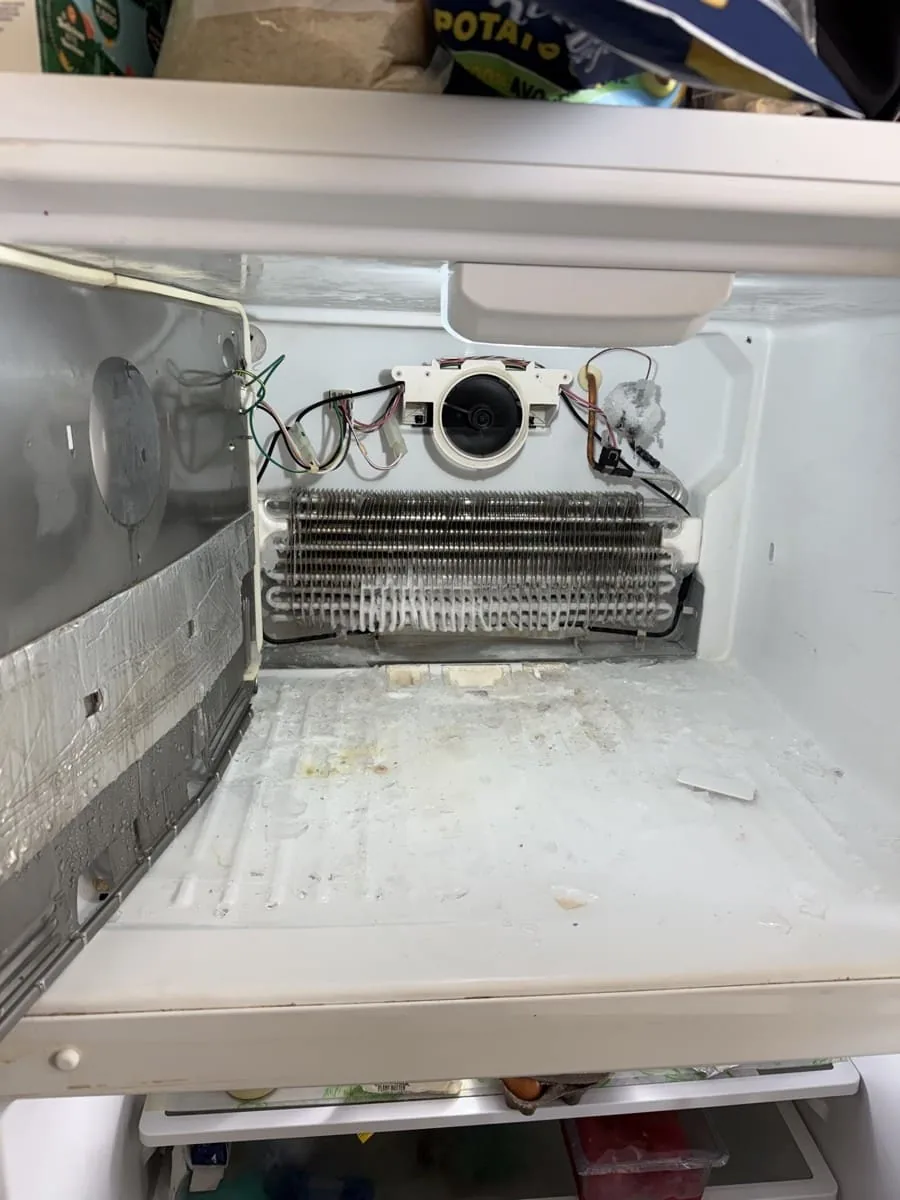
A second evaporator fan failure mode is frozen evaporator coils. If the defrost system isn't working, ice builds up on the coils until airflow is completely blocked. The freezer may still be cold from direct contact with the frozen coils, but no air circulates to the refrigerator section.
Unplugging the refrigerator for 24 hours sometimes restores function temporarily. But it will freeze again within a week or two if the defrost heater, thermostat, or timer isn't replaced. A temporary defrost is useful for confirming the diagnosis — not for solving it.
8. Air damper control
The air damper is a small door or baffle between the freezer and refrigerator compartments. It controls how much cold air flows from the freezer into the refrigerator section. When it fails — stuck open, stuck closed, or broken — the refrigerator section gets either too cold or not cold enough.
If the freezer is working fine but the refrigerator section is warm even after ruling out the evaporator fan, check whether the damper is stuck closed. On most models it's accessible through the refrigerator compartment ceiling or back wall. A stuck damper is a relatively inexpensive repair — the part costs $20–$60 and takes about 30 minutes to replace.
9. Start relay
The start relay is a small component on the side of the compressor. When it fails, the compressor tries to start, fails, and shuts down. Then tries again. The symptom is a clicking sound every few minutes.
You can test it: pull the refrigerator away from the wall, locate the compressor (a black dome-shaped component at the back or bottom), and find the start relay — a small rectangular or cylindrical component that plugs directly onto the side of the compressor. Pull it off and shake it near your ear. If it rattles, it has failed.
A start relay costs $10–$30. It takes a technician about ten minutes to replace. It's one of the most common repairs on refrigerators that have "stopped completely."
The defrost components tested fine on a Frigidaire that came in looking like a classic defrost failure. The real problem was deeper in the unit — a wiring connector that had corroded and burned through. The wire going to the inverter had failed at the connector, not at any component. A part nobody would have ordered. That's why we diagnose before we quote.
10. Sealed system issues
If none of the above checks identify the problem, the likely cause is inside the sealed refrigeration system: low refrigerant from a leak, a failed compressor, or a failed condenser. These require a technician with EPA certification for refrigerant handling.
A refrigerant leak: the refrigerator runs constantly, the compressor is warm, but neither compartment is getting cold. Compressor failure: the compressor runs very briefly and stops, or doesn't run at all.
The economics of sealed system repairs depend heavily on the refrigerator's age. A compressor replacement on a 3-year-old refrigerator usually makes sense. The same repair on a 14-year-old unit rarely does. The $89 diagnostic gives you an honest assessment before you commit to anything.
Is It Worth Repairing?
A general rule: if the repair cost exceeds half the price of a comparable new refrigerator, replacement is usually the better financial decision. For a failed compressor on a 12-year-old unit, replacement often wins. For a start relay, a fan motor, or a door gasket on a refrigerator in otherwise good condition, repair almost always makes sense.
On parts: OEM is not automatically better than aftermarket. Samsung OEM suspension components cost $420 for a set. The aftermarket equivalent costs $45 and is physically built heavier — thicker shaft, thicker spring. That's what we install, and the callback rate on it is zero. The brand on the part doesn't determine how long it lasts.
We carry the most common refrigerator parts on the truck. Most repairs are same-day. The 12-month parts and labor warranty covers the work.
Food Safety During a Cooling Failure
The FDA guideline for refrigerator food safety is four hours without adequate cooling. After that, perishables — meat, fish, dairy, cooked food, cut produce — should be discarded. Keep the door closed as much as possible.
A full refrigerator holds temperature longer than a half-empty one. A refrigerator thermometer (under $10) lets you track the actual temperature rather than guessing. Once the interior reaches 40°F, the clock starts — FDA's safe food storage guidance is what that number comes from.
The freezer holds temperature for 24–48 hours if left closed. A full freezer holds longer than a half-full one.
See the full list of refrigerator repair services we cover.
Tony
Licensed Electrical Contractor · ER-13016759 · Tampa Bay, FL
Owner of My Fixer LLC, serving Tampa Bay since 2018. 337 Google reviews at 4.9 stars.
About Anatoliy →Frequently Asked Questions
Why is my refrigerator not cooling but the freezer is fine?+
The most common cause is a failed evaporator fan motor — the fan that moves cold air from the freezer into the refrigerator compartment. A stuck or failed air damper is a close second. Frozen evaporator coils blocking airflow is also common. All are repairable. A technician can confirm which one within a few minutes of opening the freezer compartment.
My refrigerator is making a clicking noise and not cooling. What is it?+
Clicking every few minutes — the compressor trying and failing to start — is a classic sign of a failed start relay. It costs $10–$30 for the part and about ten minutes to replace. It's one of the most common refrigerator failures and one of the least expensive to fix.
My refrigerator runs constantly but isn't cold. What's wrong?+
Constant running with inadequate cooling usually points to dirty condenser coils, a failed condenser fan motor, a refrigerant leak, or a bad door gasket letting warm air in continuously. The refrigerator is working as hard as it can but can't overcome the underlying problem. Dirty coils are the most common and easiest to rule out — vacuum them first.
The temperature in my refrigerator fluctuates a lot. Is that normal?+
Minor fluctuations of 1–3°F are normal when the compressor cycles. Swings of 5°F or more, or temperatures consistently above 40°F, are not. Common causes: a failing door gasket, a worn thermostat, or a defrost system that isn't clearing properly, causing partial airflow blockage. The $89 diagnostic identifies which one.
My refrigerator is making a loud buzzing noise. What causes that?+
A steady buzzing or humming that's louder than normal usually points to the compressor struggling to run — often a failing start relay or a compressor near the end of its life. A buzzing that stops and starts every few minutes is the start relay trying and failing. A buzzing from the back of the unit is often the condenser fan hitting something. The location and pattern help narrow it down.
Is it worth repairing an older refrigerator?+
If the repair costs more than half the price of a comparable new unit, replacement usually makes more sense. For a compressor failure on a 12-year-old refrigerator, replacement often wins. For a fan motor, start relay, gasket, or air damper on a 5-year-old unit, repair almost always does. The $89 diagnostic gives you an honest assessment before committing.
How long can food stay safe in a refrigerator that's not cooling?+
The FDA guideline is four hours once the refrigerator is no longer maintaining adequate cooling. Keep the door closed to slow the temperature rise. Perishables — meat, dairy, cooked food — should be discarded once the interior reaches 40°F. A refrigerator thermometer tells you exactly where you stand. The freezer holds 24–48 hours if left closed.
Can I clean refrigerator condenser coils myself?+
Yes. Pull the refrigerator away from the wall, locate the coils at the back or underneath (remove the kick plate), and vacuum with a brush attachment. Takes about 15 minutes. Do this every 6–12 months — more often with pets. It's the single most effective maintenance task for keeping a refrigerator running efficiently.
How much does refrigerator repair cost?+
The $89 diagnostic fee covers the visit and diagnosis and applies toward the repair cost. Common repairs — start relay, fan motor, door gasket, air damper — typically start at $100 parts and labor. Defrost system repairs start at $150. Sealed system work (compressor, refrigerant) costs more and depends on the refrigerator's age and replacement value.
Have a Question?
Ask our licensed electrician directly. Electrical and appliance repair specialist. You'll get a reply within minutes.